Why ancient DNA needs a provenance layer
Ancient DNA has transformed our ability to reconstruct the past. From fragments of genetic material recovered from human remains, animal bones, teeth, sediments and archaeological material, researchers can now investigate questions that would have been almost unimaginable a generation ago — observing population movements across continents, reconstructing relationships between ancient communities, tracing the emergence and spread of pathogens, examining the domestication of animals, and identifying biological events separated from us by thousands, sometimes hundreds of thousands, of years. The scale of the transformation is remarkable.
But as archaeogenomics becomes larger, more computational and increasingly dependent on the reuse of existing datasets, another problem becomes more important: where, exactly, did the evidence come from? Not simply the biological specimen — the analytical result. A sequence deposited in a repository may have travelled through archaeological excavation, sampling, laboratory preparation, sequencing, bioinformatic processing, filtering, reference alignment, authentication, statistical analysis, publication, aggregation and subsequent reanalysis. Each stage contributes something to what eventually becomes a scientific claim.
Ancient BioChain begins with a deceptively simple proposition: a scientific result should carry its history with it. That history is provenance — and in ancient DNA, provenance matters enormously.
Ancient DNA is a chain of evidence
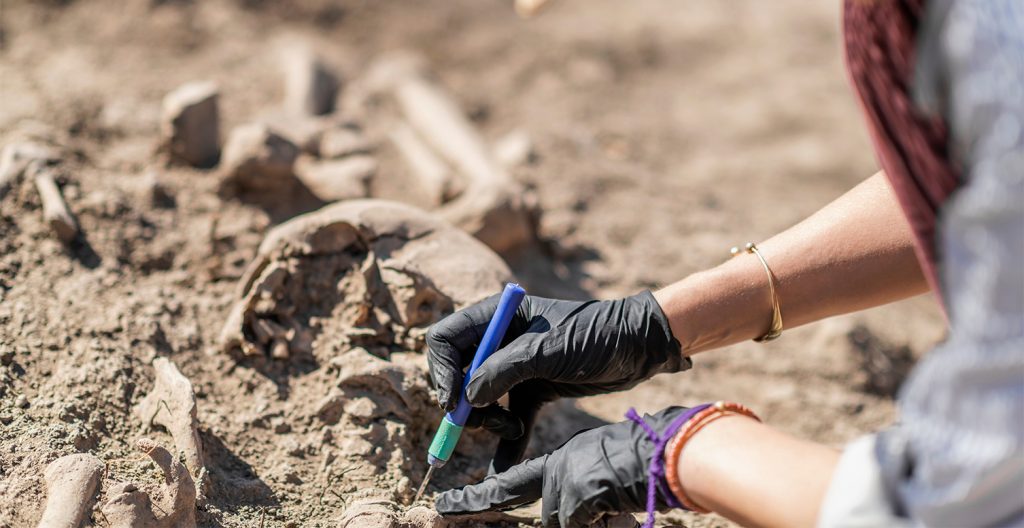
Consider a hypothetical ancient human genome. A tooth is recovered from an archaeological site. Its archaeological context associates it with a particular burial; radiocarbon dating establishes an estimated age. A laboratory samples material from the tooth, extracts DNA, and converts it into sequencing libraries. Sequencing produces raw reads, which are then processed: adapters are removed, reads are filtered, sequences are aligned against a reference genome, duplicates may be removed, damage patterns are examined, contamination is estimated, genetic sex may be inferred, and population-genetic analyses are performed. Eventually the individual appears in a publication. Later, information from that publication may enter a larger dataset — and still later, another researcher downloads that dataset and uses the individual in an entirely different analysis.
What is commonly described as an “ancient genome” is therefore not a single piece of evidence. It is the product of an evidence chain:
Site → Context → Specimen → Sample → Laboratory → Library → Sequencing → Raw Data → Processing → Analysis → Dataset → Publication → Reanalysis
Every arrow matters. Change something at one stage and the interpretation downstream may change with it.
The problem of distance
Modern science is extraordinarily good at distributing data. Repositories allow sequencing data to be preserved and accessed internationally; community datasets make large-scale population analyses possible; standards and computational workflows increasingly support reproducible research. But successful distribution creates a new problem: researchers become progressively more distant from the original specimen. The scientist performing a continental-scale population analysis may never have visited the archaeological site, handled the skeletal material, or communicated with the laboratory that generated the sequence — and that is not a criticism, it is precisely what makes large-scale collaborative science possible. But it changes the infrastructure that science requires. When researchers cannot personally know the history of every observation, the data infrastructure must preserve that history for them.
Provenance is more than metadata
Metadata tells us something about an object; provenance tells us what happened to it. A sample might have metadata describing its archaeological site, geographic coordinates, estimated date, skeletal element, biological sex, sequencing platform and repository accession — all useful, but provenance asks different questions. Who created this record? Which specimen was sampled? Which dataset was derived from which sequencing run? What processing occurred, and which version of a workflow was used? Was a record subsequently corrected? Which publication introduced an interpretation, and which later dataset incorporated it — and what changed between versions? These are questions about relationships and history. A provenance system does not merely describe evidence; it describes the chain through which evidence became knowledge.
Why ancient evidence presents a special problem
Ancient biological material has characteristics that make provenance particularly important. It is finite. Sampling may be destructive. DNA is degraded, and contamination can materially affect interpretation. Analytical techniques change rapidly, reference datasets evolve, chronological estimates can be revised, and archaeological interpretations can change. Samples may acquire multiple identifiers as they move between institutions and publications, and the same ancient individual may subsequently appear in numerous datasets and hundreds of analyses. Unlike a modern clinical sample, researchers cannot simply obtain another blood draw from someone who died five thousand years ago — the underlying biological material is irreplaceable. That makes the history surrounding its transformation into digital evidence unusually valuable.
A graph, not a filing cabinet
Ancient BioChain approaches this problem by treating scientific provenance as a network of connected events. Imagine an archaeological specimen represented as an object: a sampling event creates a relationship between that specimen and a laboratory sample; an extraction event connects the sample to extracted DNA; a sequencing event connects that material to sequence data; a computational process connects raw reads to derived files; a publication connects analytical outputs to scientific interpretation; and a later dataset connects that published evidence to another research context. Rather than flattening these relationships into a spreadsheet, they can be represented as a provenance graph — which makes a different kind of question possible. Instead of asking “what information do we have about sample X?”, we can ask “show me everything that happened between specimen X and result Y.” That is a fundamentally different way of thinking about scientific records.
The chain must remain open
Ancient BioChain is not intended to create another isolated database of ancient genomes. The field already has important repositories, standards, community resources and analytical ecosystems, and replacing them would solve the wrong problem. The objective is to connect evidence across them: a sequence accession should remain a sequence accession, an archaeological identifier should remain meaningful within its archaeological context, a DOI should continue identifying a publication, and existing community datasets should remain useful. The provenance layer sits between these systems, recording relationships rather than demanding that every system be replaced. This principle is central to the wider BioChain architecture: the evidence layer should connect scientific infrastructure, not compete with it.
Public data as a test
The first Ancient BioChain implementation deliberately begins with public archaeogenomic data. Resources including established ancient DNA datasets, community data structures and public sequence repositories provide an opportunity to reconstruct evidence chains from information that already exists. This creates an interesting experiment: how much of the history of an ancient genetic observation can be reconstructed automatically? Where do identifiers connect cleanly, and where are relationships ambiguous? Where has provenance been preserved only in supplementary tables or publication text — and where does the chain disappear completely? Those gaps are themselves informative. They reveal where scientific infrastructure preserves evidence well, and where important relationships remain dependent on human interpretation.
Ancient pathogens
The same architecture becomes particularly interesting when applied to ancient pathogens. Ancient pathogen genomics allows us to examine infectious disease across historical timescales: pathogens recovered from archaeological remains can illuminate the evolution and geographical movement of diseases, the relationship between epidemics and human migration, and changes in pathogen populations over centuries. But these analyses can involve exceptionally complex evidence chains. An archaeological individual may be sampled, with DNA initially sequenced for human population analysis; pathogen DNA may subsequently be identified within those reads; a later study may reconstruct a pathogen genome; and that genome may then become part of a phylogenetic analysis alongside ancient and modern isolates. The final evolutionary conclusion can therefore sit many transformations away from the original archaeological specimen. Being able to traverse that chain is scientifically valuable, and it also provides a bridge between archaeogenomics and modern genomic surveillance — the technologies differ, but the underlying question does not: can we show where the evidence came from?
Reproducibility is partly an infrastructure problem
Scientific reproducibility is often discussed in terms of methods — were the methods described sufficiently, is the code available, can the analysis be rerun? Those questions are essential, but reproducibility also depends on identity and provenance: do we know exactly which data were analysed, which version, derived from which source, processed how, using which reference, under which assumptions? If those relationships cannot be reconstructed reliably, perfect analytical code cannot completely reproduce the original evidential context. Reproducibility therefore begins before an analysis script is executed — it begins with the evidence chain.
What Ancient BioChain is trying to demonstrate
Ancient BioChain is an experiment in making those chains visible. The immediate objective is not to answer a particular archaeological question; it is to build infrastructure through which many questions can be examined with stronger provenance. As the project develops, we will use Origins to explore the datasets, technologies and scientific questions surrounding that work — following ancient DNA, tracing ancient pathogens, investigating difficult provenance chains, and looking at cases where apparently simple datasets conceal surprisingly complicated histories. We will document what happens when biological evidence travels across decades, institutions, repositories, publications and computational analyses.
Because the extraordinary thing about ancient DNA is not simply that biological information can survive for thousands of years. It is that fragments of that information can be transformed into evidence about people, animals, pathogens and events that no living person witnessed. If those conclusions are to become part of the scientific record, preserving the route from fragment to finding matters.
The sequence is data. The chain that produced it is evidence.
Key Takeaways
- A published ancient genome is the product of a long evidence chain — excavation, sampling, laboratory work, sequencing, computational processing, analysis, publication and reanalysis — not a single piece of evidence.
- As archaeogenomics becomes more collaborative and dataset-driven, researchers grow more distant from the original specimen, which means the data infrastructure has to preserve the history they can no longer witness firsthand.
- Provenance is not the same as metadata: metadata describes an object, provenance describes what happened to it and why one record depends on another.
- Ancient biological material is finite, degraded and irreplaceable, which makes the history behind its transformation into digital evidence unusually valuable.
- Ancient BioChain represents this history as a provenance graph — connected events between specimen, sample, sequence, dataset and publication — and is designed to connect existing repositories and standards, not replace them.
Questions & Answers
What is a provenance graph?
A provenance graph represents scientific evidence as a network of connected events — sampling, extraction, sequencing, processing, publication and reuse — so a user can ask what happened between a specimen and a result, not just what is known about each in isolation.
Does Ancient BioChain replace existing ancient DNA repositories?
No. Ancient BioChain is designed to connect evidence across existing repositories, standards and community datasets, not to replace them — identifiers and accessions continue to mean what they already mean.
Why does ancient DNA make a good test case for provenance infrastructure?
Ancient samples are finite, often destructively sampled, and subject to evolving methods and reference datasets, so the surrounding evidence trail matters more than it does for material that can simply be resampled.